
Understanding Municipal Lighting Standards and Their Impact on Site Design
—
Most communities have detailed regulations governing building height, setbacks, landscaping, and parking. Increasingly, municipalities are also taking a closer look at exterior lighting as part of the development review process.
From light spill limitations to Dark Sky initiatives, exterior lighting regulations have become a standard checkpoint in site development. While these requirements are often associated with environmental stewardship, they also affect neighboring properties, driver visibility, pedestrian comfort, public safety, and overall community character. For project teams, this reality demands that exterior lighting move up the agenda, requiring thoughtful consideration far earlier in the design process.
What Are Municipal Lighting Standards?
Municipal lighting standards regulate how exterior lighting performs across a property. Depending on the jurisdiction, these codes may address maximum foot-candles or candela, light spill at property lines, fixture design, cutoff ratings, pole heights, glare control, and lighting curfews.
The goal is not simply to limit light, but to ensure that lighting is directed where it is needed while minimizing negative impacts on surrounding properties. Most people have experienced the effects of poorly designed lighting – maybe without realizing it. It may be the glow of a city visible from miles away, artificial light spilling into bedroom windows, or a harsh glare from a streetlamp that makes it harder, not easier, to see. Municipal lighting standards are designed to reduce these impacts without compromising safety and usability.
How Do Local Priorities Shape Lighting Requirements?
Local lighting requirements inevitably reflect a community’s broader goals and values. One municipality might prioritize protecting nearby residential neighborhoods from light pollution, while others may place greater emphasis on energy efficiency, environmental stewardship, public safety, community aesthetics, or long-term infrastructure planning
These differing values lead to distinct regulatory approaches:
-
- Precise Photometrics: Some jurisdictions enforce strict numerical thresholds for foot-candle levels, uniformity, and light spill at and extending beyond the project boundary. In these instances, extensive documentation is required in the form of a point-by-point photometric to demonstrate compliance.
-
- Flexible Performance Criteria: Other communities rely on broader performance standards, giving designers flexibility as long as they demonstrate that adjacent properties will remain unaffected.
-
- Pole Height and Mounting Standards: Maximum mounting heights are often regulated based on site zoning and adjacent land uses. These restrictions help control glare and minimize light trespass onto neighboring properties..
-
- Lighting Controls: Increasingly, municipalities are requiring lighting control strategies to reduce energy consumption and limit light pollution during off-peak hours. The City of Westfield requires certain site lighting to dim to no more than 65% output after 11:00pm.
-
- Accent Lighting: Some municipalities regulate architectural and landscape accent lighting separately from general site illumination. When upward-directed lighting is permitted, requirements often include limits on aiming angles, intensity, or lumen output to reduce unnecessary sky glow.
-
- Architectural Character: Some municipalities establish aesthetic requirements for lighting fixtures to maintain visual consistency throughout the community. These requirements may govern style, finish, color, decorative elements, or even approved manufacturers and product lines. For example, the City of Fishers requires roadway lighting to be finished in “Fishers Green,” a custom RAL color, and both Fishers and Muncie maintain fixture-specific standards in certain public-facing areas.
-
- Wayfinding and Smart Infrastructure: Modern lighting poles often serve multiple functions beyond illumination, integrating cameras, banner arms, public Wi-Fi, environmental monitoring equipment, and other technologies. Some municipalities now encourage or require these features to support public safety, connectivity, and wayfinding objectives.
Because codes vary so widely between neighboring towns, we make it a priority to clarify and understand local expectations before site layouts, pole placements, fixture selections, and lighting control strategies are finalized.
Why Do Early Photometrics Matter?
One of the most valuable tools in the site lighting design process is the photometric plan – a drawing that models predicted light levels and distribution patterns across a site. By mapping fixture performance, mounting heights, pole placement, and site topography together, we can evaluate lighting impacts before construction begins.
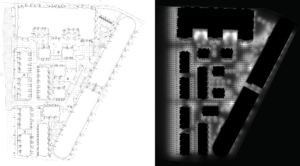
Site Photometric Rendering
This analysis frequently reveals concerns that are otherwise invisible on a standard two-dimensional site plan:
-
- Light levels near property lines may exceed municipal limits
- Certain areas may be underlit, creating safety hazards or failing to meet uniformity requirements
- Pole locations may conflict with landscape features, utilities, or circulation patterns
- Glare may become a concern for adjacent roadways or neighboring properties
- Egress pathways may not meet required illumination levels between building exits and the public right-of way
Resolving these issues during the initial design phase is far more efficient than addressing them during permitting or construction. Adjusting a pole location or changing fixture distribution on paper takes minutes; fixing a non-compliant installation on-site can cause expensive delays and rework.
At KBSO, we’ve seen how early lighting planning naturally improves broader civil coordination. Exterior lighting influences, and is influenced by grading, utility infrastructure, easements, and landscaping. When lighting is treated as an afterthought, these opportunities for coordination are missed, making late-stage revisions almost inevitable.
Beyond Code Compliance
Not every municipality has detailed lighting requirements. In those cases, we must rely on industry best practices, owner expectations and preferences, and site-specific goals to guide decisions. Even without a formal lighting ordinance in place, photometric modeling remains invaluable for developing lighting layouts that support visibility and safety while minimizing unnecessary light spill and glare.
Quality lighting design is ultimately about more than satisfying a code requirement. It is about creating a safe, welcoming environment that respects neighboring properties and operates reliably for years. By treating lighting as a core design element from day one, we help project teams streamline permitting timelines, protect project budgets, and deliver site designs that serve both owners and their surrounding communities.

About
Melissa Laviolette, LEED AP BD+C, NCQLP LC
Lighting Designer
Melissa is an accomplished lighting designer renowned for her expertise across various project types. With a mastery of both aesthetic design principles and technical intricacies, she transforms spaces into captivating environments by integrating lighting to enhance architecture and elevate ambiance. She utilizes cutting-edge technology to orchestrate dynamic, energy-efficient solutions tailored to each client’s vision. With a passion for innovation and a commitment to excellence, she collaborates with architects, interior designers, and clients to deliver unparalleled lighting experiences that surpass expectations.