
Humidity Control + HVAC Strategies for Archives and Libraries
—
Humidity may be a comfort issue for people. For archives, it’s a preservation issue. Paper, photos, film, and textiles are hygroscopic materials – they absorb and release moisture from the air. When humidity rises, these materials swell; when it drops, they shrink. Over time, this cycle leads to mold growth, cracking, warping, fading, and permanent loss of information.
Because of this, environmental control in libraries and archives calls for a more deliberate, specialized approach – one that connects how materials age, how mechanical systems behave, and how small environmental shifts can have long-term consequences.
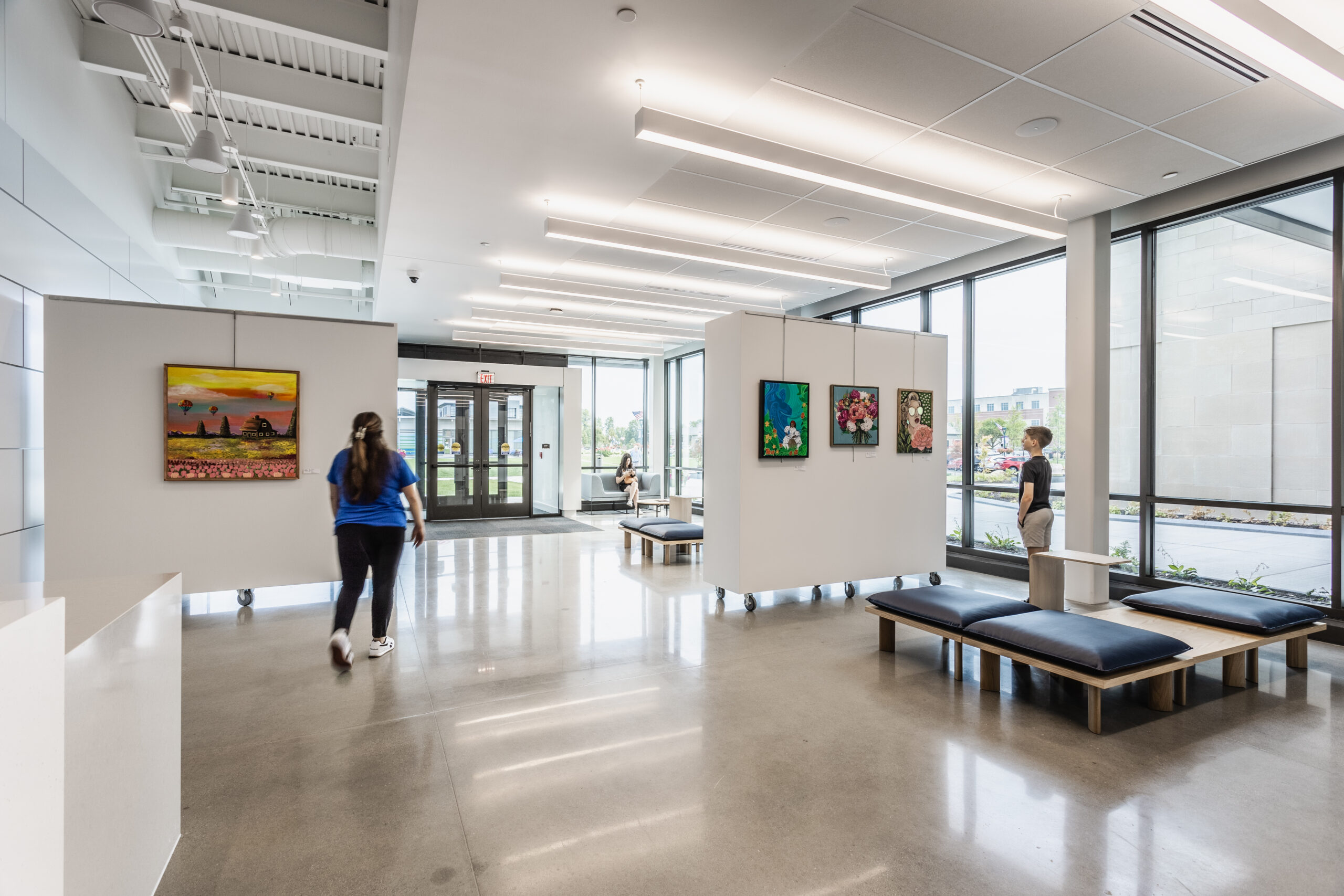
Fishers Arts and Municipal Complex
Why Stability Matters More Than a Perfect Number
Two principles shape nearly every design decision we make:
01. Temperature stability drives humidity stability.
A 5°F temperature swing can shift relative humidity (RH) by about 10% – even if no moisture is added. Daily operations can trigger these swings: a sunny patch in an unshaded reading room, a large group arriving at once, or equipment cycling on. A 10% RH jump is enough to push mixed collections into mold‑risk territory or cause noticeable shifting or distortion in sensitive materials.
02. Mold risk follows relative humidity.
Mold doesn’t require extreme conditions to grow – just humidity that stays elevated for long enough. Sustained RH above about 60% significantly increases the likelihood of mold germination, so minimizing long periods of high humidity is one of the most effective protective measures.
In archival environments, avoiding rapid changes is often more protective than chasing a single ideal number.
Why Rate of Change Matters
According to the 2023 ASHRAE Handbook – HVAC Applications, Chapter 24, materials like wood, paper, leather, paint layers, and adhesives are especially vulnerable to rapid environmental shifts. They can tolerate slow, gradual changes far better.
Stress relaxation – the process where materials slowly adjust to environmental changes – works in our favor. A sudden 10% RH jump forces materials to absorb that stress all at once; a gradual shift allows movement without damage. In practice, a system that allows gentle, predictable movement provides better long‑term protection than one that overworks to maintain one perfect number.
How HVAC Systems Protect Collections
Translating these principles into practice means designing systems that react calmly, not abruptly, by:
Anticipating fast load swings.
Sudden changes in temperature and humidity stress sensitive materials. Good HVAC design anticipates these shifts and responds gradually to maintain stable conditions.
Commissioning controls with intention.
Control sequences should respond in a steady, intentional way instead of reacting to every tiny fluctuation. Thoughtful commissioning reduces overshoot, minimizes cycling, and supports long-term environmental stability.
Managing pressure relationships.
Subtle differences in pressure protect materials and indoor air quality. Collection spaces are maintained at slightly positive pressure, so conditioned, filtered air moves outward. High‑pollutant areas (loading docks, trash rooms, kitchens) are kept slightly negative, so air is drawn inward rather than drifting toward sensitive zones.
Evaluating the building envelope.
Before adding humidification, it’s important to understand how well the building actually holds air and moisture. In a leaky envelope, added moisture can migrate into walls or ceilings and condense, causing corrosion, rot, or microbial growth. Sometimes, the safest solution is to improve the envelope or adjust humidity targets to protect both the structure and the collection.
Setting Goals (and Understanding the Tradeoffs)
Most mixed collections perform well within a moderate, stable band – typically around 45-55% RH and 60-70°F, depending on materials and use. Preservation exists on a spectrum: lower temperatures and humidity slow chemical aging, but they also increase system complexity, energy use, and operational cost.
Our job is to help owners understand how different approaches affect long‑term preservation, system reliability, and day‑to‑day operations so they can make informed, resilient decisions.
Standards We Rely On
-
- 2023 ASHRAE Handbook – HVAC Applications, Chapter 24: Museums, Galleries, Archives, and Libraries
-
- NARA 1571, Archival Storage Standards
KBSO’s Approach
We start by understanding the collection, the building, and the owner’s goals. From there, we evaluate design options – how they perform, what they cost to operate, and how they support long‑term reliability.
We design systems that deliver consistent, predictable conditions: equipment that modulates smoothly, humidification and dehumidification sized for real‑world conditions, and controls that measure accurately and respond intentionally. We also assess building envelope performance and the need for redundancy, ensuring the system can maintain stable conditions through seasonal extremes or unexpected events.
Because daily operations drive long‑term stability, we work alongside owners and facility teams to establish expectations for seasonal behavior, control sequences, and maintenance practices that support reliable, resilient performance. This combination of clear communication, thoughtful engineering, and ongoing partnership helps protect collections and support reliable building operation.

About
Andy Steiner, PE, LEED AP BD+C
Sr. Mechanical Engineer
Andy is a skilled mechanical engineer with a keen aptitude for project management. He excels at coordinating complex mechanical systems and fosters a collaborative client environment, delivering unique solutions that optimize life cycle costs. As a Certified GeoExchange Designer in Training, he integrates sustainable practices into his designs, optimizing energy efficiency and reducing environmental impact. Andy’s multi-disciplinary approach and expertise ensure that each client receives innovative solutions that align with their goals and values.