
Geothermal Design at KBSO Consulting
—
Building owners are increasingly looking for ways to reduce energy use, lower carbon emissions, and manage long-term operating costs. Geothermal systems help achieve those goals by using the earth’s stable underground temperatures to transfer heat into and out of buildings, providing highly efficient heating and cooling throughout the year. However, successful implementation depends on more than the technology itself. It requires careful analysis, informed decision-making, and planning that looks well beyond the day a building opens.
At KBSO Consulting, geothermal design is part of our commitment to sustainable, forward-thinking solutions. But it is not a one-size-fits-all answer. Our role is to help owners understand whether it’s the right fit, and, if it is, design a system that performs reliably throughout the life of the facility.
Defining Project Goals
Our geothermal work follows a consistent, rigorous process, but every solution is shaped by the specific needs of each project. Operational needs, budget, long-term plans, site conditions, and environmental goals all influence what the right system looks like.
We evaluate geothermal systems alongside conventional alternatives so owners can clearly compare upfront cost, operating cost, maintenance, and carbon impact. Sometimes an option is easily eliminated because it costs more without delivering meaningful savings, and that’s a valuable result, too. We also treat the wellfield as the long-term asset it is. Wells and buried piping can serve a facility for generations, so decisions about field size, location, and capacity should account for future growth, not just today’s project.
Developing the Geothermal Design
Once project goals are defined, we move into detailed analysis. Each step builds on the last, giving owners a clear, data-driven picture of how a geothermal system will perform, what it will cost, and how it compares to the alternatives.
Energy Modeling and Load Analysis
We build hourly energy models based on how a building is actually used, accounting for occupancy schedules, events, and operating hours. These models show how much heating and cooling the building needs throughout the year and form the basis for the steps that follow.
System Configuration
Geothermal systems can be configured in several ways. A central heat pump plant can distribute hot and chilled water to air handling units throughout a building, while individual zone heat pumps can connect directly to the ground loop. We evaluate each approach against the building’s needs, including the level of redundancy required to maintain reliable operation.
Wellfield Sizing and Long-Term Performance
Using ground loop design software, we determine the wellfield size needed to meet the building’s heating and cooling loads, then forecast loop–water temperatures over time. A wellfield must remain in thermal balance. If more heat is extracted from the ground than is returned, the field can gradually overcool, reducing long-term performance.
Strategies like pairing buildings with complementary loads or incorporating supplemental heat sources can help maintain that balance. This process is inherently iterative: loop temperatures influence equipment efficiency, equipment efficiency affects energy consumption, and energy consumption ultimately impacts wellfield performance.
Life-Cycle Cost Analysis
We evaluate capital costs, annual energy and maintenance expenses, equipment replacement cycles, and available incentives over 10–, 20–, and 30-year periods. This approach gives owners a clear understanding of payback and total cost of ownership, not just initial construction costs.
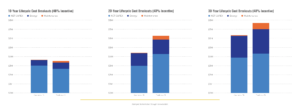
Sample Life-Cycle Cost Analysis
Planning for the Future
Some of the most impactful geothermal decisions occur at the master planning level. A system might start by serving a single building but be designed to expand to multiple buildings or an entire campus over time.
We evaluate options ranging from standalone systems to district-scale plants and identify the mechanical room space, piping infrastructure, electrical capacity, and wellfield area needed to support future expansion. Planning for growth early helps owners avoid costly limitations later.
Integrated Coordination
Geothermal systems affect every design discipline. Wellfields impact site planning and landscaping. Central plants need mechanical room space and structural support. Pumps and heat pump equipment drive electrical service and distribution requirements.
Local geology and subsurface conditions matter, too. In central Indiana, limestone formations and underground voids can change well depth and quantity. For that reason, we typically require test wells to verify assumptions before final design.
The Outcome
Across all of our projects, the goal is the same: deliver solutions that lower operating costs, reduce carbon impact, and perform reliably for decades.
At KBSO, we help owners make confident, informed decisions about geothermal systems by connecting long-term sustainability goals with practical, data-driven design.

About
Andy Steiner, PE, LEED AP BD+C, CGDIT
Mechanical Engineer
Andy is a skilled mechanical engineer with a keen aptitude for project management. He excels at coordinating complex mechanical systems and fosters a collaborative client environment, delivering unique solutions that optimize life cycle costs. As a Certified GeoExchange Designer in Training, he integrates sustainable practices into his designs, optimizing energy efficiency and reducing environmental impact. Andy’s multi-disciplinary approach and expertise ensure that each client receives innovative solutions that align with their goals and values.