
How Metering Strategies Vary Across Market Sectors
—
In the early stages of MEP design, metering is often treated as a utility function – a necessary but secondary box to check. At KBSO Consulting, we treat it as a fundamental building block of infrastructure that must be established well before the first wire is pulled.
While it’s commonly associated with utility billing, metering extends far beyond tracking kilowatt-hours. A well-defined strategy supports power quality analysis, energy monitoring, demand management, and integration with building management systems (BMS). These are not operational afterthoughts; they are design drivers that influence how electrical systems are distributed, connected, and ultimately experienced by the end user.
Although the hardware may remain consistent, the strategic intent shifts based on market type. The distinction is not just how much power is used – it is about defining responsibility, enabling system visibility, navigating legal constraints around energy resale, and protecting long-term owner investment.
Where Are the Legal Boundaries?
A common misconception is that building owners can distribute and charge occupants for power at their own discretion. In reality, strict legal frameworks – particularly in residential settings – prohibit building owners from acting as unregulated utility providers.
In mixed-use and multifamily developments, metering must be highly granular. Because owners generally cannot profit from or directly manage residential energy costs, financial responsibility is passed to the occupant. This requires a large number of individual meters, demanding early coordination to address spatial and architectural impacts. Without this coordination, exterior meter banks can quickly overwhelm the building’s aesthetic and accessibility requirements.
Commercial and higher education environments offer more flexibility, but with different objectives. For commercial tenants, submetering is often used to allocate utility costs accurately. The goal is transparency – billing tenants for actual consumption rather than generating profit. For higher education campuses, the institution is responsible for utility costs. Here, metering is less about billing and more about performance, benchmarking, and long-term planning. Energy use is tracked at building, system, and equipment levels to support sustainability initiatives and identify inefficiencies across their portfolio.
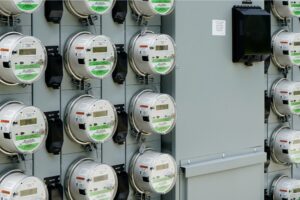
Multifamily Development Meter Bank
Why Does Early Coordination Matter?
When metering is treated as an afterthought, spatial and system constraints become difficult to resolve. Architectural intent is often compromised by late-stage electrical infrastructure requirements.
At KBSO, metering is integrated into initial load calculations, allowing both equipment placement and system architecture to align with the building layout from the start. This coordination ensures utility requirements, monitoring goals, and long-term operations are addressed without compromising curb appeal or triggering costly redesigns mid-construction.
This approach is especially critical in projects with advanced energy goals. LEED certification, internal sustainability targets, or operational efficiency standards may require system-level submetering – tracking lighting, receptacles, HVAC, and other major loads independently. These requirements directly influence branch circuit grouping, panel organization, and overall electrical distribution.
Facilities requiring BMS integration – particularly campuses and large commercial buildings – add another layer of complexity. Compatibility with communication protocols, network pathways, and meter placement must be coordinated early to ensure data can be captured, transmitted, and used effectively.
How Can Design Account for Tenant Ambiguity?
A significant risk in multifamily and mixed-use projects is the gap between the intended tenant and the actual tenant. A developer may plan for five retail shops, but by the end of construction, the space may be leased to two retailers and a restaurant – a high-demand tenant whose specialized equipment requires significantly more power than a standard shop.
If infrastructure hasn’t been sized to accommodate that potential load, increasing capacity after construction – particularly at the transformer level – becomes significantly more expensive and disruptive.
To mitigate this risk, we design for flexibility using:
-
- Overarching Conduit Paths: Conduit is routed into tenant spaces without pulling wire until needs are finalized, allowing the infrastructure to adapt without rework.
-
- Provisional Load Sizing: Infrastructure is sized using local and national code requirements and tenant diversity assumptions, creating flexibility without requiring owners to overinvest upfront.
-
- Tenant Contract Review: When possible, early lease review helps define billing structures and the appropriate level of metering granularity.
-
- Future Monitoring Capacity Even when advanced energy monitoring isn’t immediately required, pathways for expansion are incorporated to support future submeters, dashboards, or BMS integration.
This approach ensures buildings can evolve without major infrastructure changes.
What Defines KBSO’s Approach?
A well-designed metering strategy simplifies the business of owning and operating a building.
At KBSO, we apply our knowledge of utility requirements, national codes, and real-world tenant behavior to solve problems before they surface. Just as importantly, we consider how energy data will be used – not only for billing, but for operations, sustainability, and long-term asset performance.
By defining the right metering strategy early, we deliver infrastructure that is flexible, compliant, and aligned with both immediate needs and future demands.
The result is a system that supports the building – financially, operationally, and architecturally – from day one.

About
Paul Records, Sr. Electrical Designer
Electrical Designer
Paul is a highly effective electrical designer and project manager. He excels in fostering strong client relationships through his commitment to high standards and personal accountability. He approaches projects from the client’s perspective, ensuring their needs remain paramount. Paul’s project coordination skills foster seamless collaboration among design teams, minimizing change orders and streamlining construction. With expertise in power distribution and lighting systems, complemented by extensive experience across diverse market sectors, he delivers innovative, user-friendly, and code-compliant solutions.